Actualités

MISE À L’ÉCHELLE – SOUTIEN À LA SIMULATION NUMÉRIQUE POUR LA CONCEPTION À L’ÉCHELLE INDUSTRIELLE

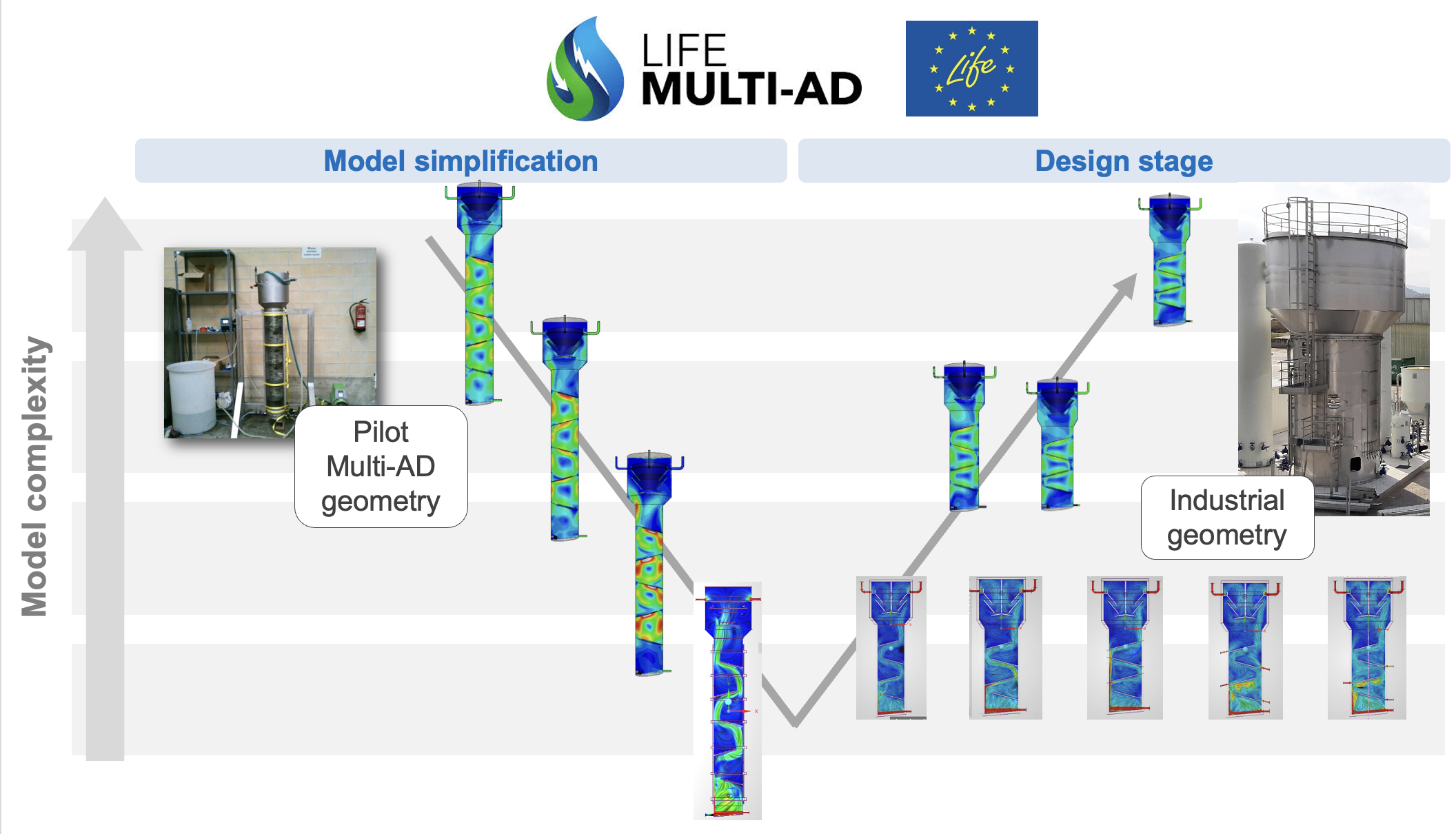
Le projet Multi-AD 4 AgroSMEs est né du réacteur anaérobie multiphase breveté par AEMA. Cette technologie a été testée expérimentalement sur un prototype à l’échelle pilote de 0,1 m3, donnant des résultats prometteurs en termes d’efficacité, d’impact environnemental et de coûts. L’un des objectifs du projet est le développement d’un nouveau design basé sur le prototype de l’AEMA et adapté à son fonctionnement à l’échelle industrielle. Ce processus de mise à l’échelle a été soutenu par la modélisation de la dynamique des fluides computationnelle (CFD), une technique qui fournit des informations sur les performances d’une nouvelle conception avant sa construction.

La dynamique des fluides numérique (CFD) utilise des méthodes numériques et des algorithmes pour résoudre des problèmes de mécanique des fluides, c’est-à-dire la branche de la physique qui étudie les mouvements des liquides et des gaz et les forces qui les provoquent. ITAINNOVA a une grande expérience de la modélisation et de la simulation CFD et de son application dans l’industrie pour la détection virtuelle, le contrôle par modèle, l’optimisation des processus et la conception de produits.

Réacteurs anaérobies pour l’hydrolyse, l’acidogenèse, l’acétogenèse et la méthanogenèse des eaux usées. La matière organique contenue dans l’eau (liquide) est mise en contact avec la biomasse (particules solides) pour la dégrader et générer du biogaz (gaz). Un mélange adéquat du liquide et des particules solides est essentiel pour obtenir des rendements de réaction élevés. Le réacteur Multi-AD tire parti de la turbulence créée par la géométrie pour assurer le mélange en évitant l’utilisation d’une agitation mécanique.

La mise à l’échelle du procédé a nécessité la modification de la conception de l’usine pilote pour l’adapter aux exigences caractéristiques des usines industrielles. Les limitations structurelles, les objectifs de sécurité et d’efficacité économique ont été les principaux défis à relever dans le processus de reconception du réacteur. Ce processus s’est déroulé en trois étapes : i) l’acquisition de connaissances sur les performances de l’installation pilote (en particulier le niveau de mélange), ii) la proposition de modifications de conception répondant aux exigences de taille industrielle et iii) l’évaluation du nouveau niveau de mélange. Les modèles et simulations CFD ont été des outils clés dans toutes ces étapes.

Un modèle complet de réacteur Multi-AD comprend un modèle multiphase (particules solides, liquide et gaz), un modèle de turbulence, et la résolution de réactions biochimiques avec des équations de transport d’énergie et d’espèces. Cette complexité rend le modèle exigeant sur le plan informatique et, par conséquent, la simulation prend du temps. Lors de la mise à l’échelle, plusieurs géométries ont dû être testées. Ce type de modèle complexe était donc incompatible avec une procédure de conception rapide.

Une méthodologie a été développée pour résoudre ce problème. Différents modèles ont été mis en œuvre pour adapter leurs caractéristiques, principalement la précision et la demande de calcul, à l’agilité requise dans chaque partie du processus. Le modèle a été modifié en trois niveaux de simplification concernant le maillage, le nombre de phases impliquées et les phénomènes étudiés. Le modèle complexe de l’usine pilote a été utilisé pour déterminer la précision de chaque simplification et les paramètres indiquant un bon mélange et une performance adéquate.

Le modèle le plus simple a permis une modification rapide de la géométrie et une simulation en temps réel. Il a été utilisé pour une première sélection de plusieurs conceptions différentes. Les résultats n’ont fourni aucune valeur précise mais des tendances indiquant les géométries les plus prometteuses. Cette sélection a été simulée et analysée à l’aide des modèles du niveau de simplification suivant pour obtenir des résultats quantitatifs et déterminer la conception la plus adéquate.

Le réacteur sélectionné représente un équilibre entre les performances, la viabilité de la construction et les coûts. Il est déjà installé dans l’usine de démonstration et sera testé dans le cadre du projet Multi-AD 4 AgroSMEs au cours des prochains mois.

Posted by Pascal Pierre
Actualidades

ESCALADO – SIMULACIÓN COMPUTACIONAL COMO SOPORTE AL DISEÑO A ESCALA INDUSTRIAL

El proyecto Multi-AD 4 AgroSMEs nació del reactor anaeróbico multifase patentado por AEMA. Esta tecnología fue probada experimentalmente en un prototipo a escala piloto de 0.1 m3, dando resultados prometedores en cuanto a eficiencia, impacto medioambiental y costes. Uno de los objetivos del proyecto es el desarrollo de un nuevo diseño basado en el prototipo de AEMA y adecuado para la operación a escala industrial. El proceso de escalado se ha apoyado en modelos de fluidodinámica computacional, una técnica que permite obtener información sobre el funcionamiento de un nuevo diseño antes de su construcción.

La fluidodinámica computacional hace uso de métodos numéricos y algoritmos para resolver problemas relacionados con la mecánica de fluidos, que es la rama de la física que estudia el movimiento de líquidos y gases, y las fuerzas que los causan. ITAINNOVA tiene amplia experiencia en el desarrollo de modelos de fluidodinámica computacional y su aplicación en la industria para sensores virtuales, control basado en modelos, optimización de procesos y diseño de productos.

Los reactores anaerobios para tratamiento de agua residual involucran numerosos procesos bioquímicos entre los que se incluyen la hidrólisis, la acidogénesis, la acetogénesis y la metanogénesis. La materia orgánica contenido en el agua (líquido) se pone en contacto con la biomasa (partículas sólidas) para degradarla y generar biogás (gas). Un mezclado adecuado entre el líquido y las partículas sólidas es esencial para lograr altos rendimientos de reacción. El reactor Multi-AD aprovecha la turbulencia generada por la geometría para proporcionar el mezclado evitando el uso de sistemas mecánicos de agitación.

El proceso de escalado hace necesaria la modificación del diseño de la planta piloto para adaptarlo a los requerimientos característicos de las plantas

industriales. Los principales retos abordados en el proceso de rediseño del reactor fueron las limitaciones estructurales, la seguridad y el objetivo de eficiencia económica. El proceso se llevó a cabo en tres etapas: i) la adquisición de conocimiento sobre el funcionamiento de la planta piloto (especialmente el nivel de mezclado); ii) las propuestas de modificación del diseño que cumplen con los requerimientos de la escala industrial; y iii) la evaluación del nivel de mezcla en el nuevo diseño. Los modelos y simulaciones de fluidodinámica computacional han sido clave para la consecución de cada una de las fases del proceso.

Un modelo completo del reactor Multi-AD incluye el modelo multifásico (partículas sólidas, líquido y gas), el modelo de turbulencia, y la resolución de reacciones bioquímicas junto a las ecuaciones de energía y transporte de especies. Esta complejidad hace que el modelo sea exigente desde un punto de vista computacional y, por tanto, la simulación consume una cantidad significativa de tiempo. Durante el proceso de escalado, varias geometrías deben ser estudiadas. Los modelos de esta complejidad son incompatibles con un procedimiento de diseño rápido.

Para abordar este problema, se ha desarrollado una metodología de escalado en la que se implementan diferentes modelos para adaptar sus características, principalmente precisión y demanda computacional, a la agilidad requerida en cada fase del proceso. El modelo se ha simplificado en tres niveles diferentes en los que se ha modificad tanto la malla, como el número de fases involucradas y los fenómenos estudiados. El modelo más complejo de la planta piloto se ha utilizado para determinar la precisión de las simplificaciones y los parámetros que indican un buen mezclado y un funcionamiento adecuado.

El modelo más simple permite modificaciones rápidas de la geometría y resultados en tiempo real de la simulación. Este modelo se ha utilizado para hacer un screening inicial de múltiples diseños diferentes. Pese a que los resultados no dan valores precisos, sí muestran tendencias que permiten determinar las geometrías más prometedoras. Esta selección de geometrías se

simula y analiza con los modelos menos simplificados para obtener resultados cuantitativos y determinar el diseño más adecuado.

El reactor seleccionado presenta un equilibrio entre el rendimiento, la viabilidad en cuanto a su construcción y los costes derivados. Este diseño está ya instalado en la planta de demostración y será probado experimentalmente dentro del proyecto Multi-AD 4 AgroSMEs durante los próximos meses.

Posted by Pascal Pierre
News

UPSCALING – COMPUTATIONAL SIMULATION SUPPORT ON INDUSTRIAL SCALE DESIGN

Multi-AD 4 AgroSMEs Project was born from the anaerobic multiphase reactor patented by AEMA. This technology was experimentally tested at a 0.1 m3 pilot scale prototype giving promising results regarding efficiency, environmental impact and costs. One of the objectives of the project is the development of a new design based on AEMAs prototype and adequate for its operation at the industrial scale. This upscaling process was supported by Computational Fluid Dynamic (CFD) modeling, a technique that provides information about the performance of a new design prior to its construction.

Computational Fluid Dynamics (CFD) makes use of numerical methods and algorithms to solve problems regarding fluid mechanics that is the physics branch studying the liquid and gaseous movement and the forces causing them. ITAINNOVA has wide experience on CFD modeling and simulation and its application on industry for virtual sensoring, model based control, process optimization and product design.

Anaerobic reactors for wastewater hydrolysis, acidogenesis, acetogenesis and methanogenesis. The organic matter contained in the water (liquid) is put into contact with the biomass (solid particles) to degrade it and generate biogas (gas). An adequate mixing of liquid and solid particles is essential to achieve high reaction yields. Multi-AD reactor takes advantage of the turbulence created by geometry to provide mixing avoiding the use of mechanical stirring.

The upscaling of the process made it necessary the modification of the pilot plant design to adapt it to industrial plants characteristic requirements. Structural limitations, safety and economical efficiency goal were the main challenges tackled in the reactor redesign process. It was accomplished in three steps: i) the acquisition of knowledge about pilot plant performance (specially the mixing level), ii) the proposal of design modifications meeting the industrial size requirements and iii) the evaluation of the new design mixing level. CFD models and simulations were key tools in all these steps.

A complete Multi-AD reactor model comprises a multiphase (solid particles, liquid and gas) model, a turbulence model, and solving biochemical reactions together with energy and species transport equations. This complexity makes the model computationally demanding and, thus, the simulation becomes time consuming. During the upscaling, several geometries had to be tested. This kind of complex model was therefore incompatible with a quick design procedure.

A methodology was developed to address this issue. Different models were implemented to adapt their features, mainly accuracy and computation demand, to the agility required in each part of the process. The model was modified into three levels of simplification concerning the mesh, the number of phases involved, and the phenomena studied. The complex pilot plant model was used to determine the accuracy of each simplification and the parameters indicating good mixing and adequate performance.

The simplest model permitted fast geometry modification and real time simulation. It was used in an initial screening of multiple different designs. Results provided no accurate values but trends indicating the most promising geometries. This selection was simulated and analyzed using the subsequent level of simplification models to obtain quantitative results and determine the most adequate design.

The selected reactor represents a balance among performance, construction viability and costs. It is already installed in the demonstration plant and will be tested within the Multi-AD 4 AgroSMEs project during the next months.

Posted by Pascal Pierre
Newsletters

1st Newsletter LIFE Multi-AD 4 AgroSMEs project

The Food & Drink (F&D) industry…
…is the second largest productive sector in the EU where more than 95% of all its companies are SMEs. Nowadays, wastewater treatment systems normally used in the field are aerobic treatments. Its energy cost is very high because of its oxygen needs being unfeasible for SMEs. LIFE Multi-AD is an innovant idea to tackle this issue.

The main objective of the LIFE Multi-AD 4 AgroSMEsproject is to develop and industrialize an innovative fully automated system for the treatment of wastewater generated by small and medium-sized companies from the Food & Drink (F&D) sector.

The LIFE program is the EU’s funding instrument for action on the environment and climate. Its general objective is to contribute to the implementation, updating and development of EU climate and environmental legislation by co-financing projects with European added value.

Posted by Pascal Pierre
Newsletter

1st Newsletter LIFE Multi-AD 4 AgroSMEs project

Industria Food & Drink (F&D)…
…este al doilea cel mai mare sector productiv din UE, unde peste 95% din toate companiile sale sunt IMM-uri. În prezent, sistemele de tratare a apelor uzate utilizate în mod normal în domeniu sunt tratamente aerobe. Costul cu energia este foarte mare, datorita nevoilor de oxigen fiind nefezabile pentru IMM-uri. LIFE Multi-AD este o idee inovatoare pentru a aborda această problemă.

Obiectivul principal al proiectului LIFE Multi-AD 4 AgroSMEs este dezvoltarea și industrializarea unui sistem inovator complet automatizat pentru tratarea apelor uzate generate de companiile mici și mijlocii din sectorul Food & Drink (F&D).

Programul LIFE este instrumentul de finanțare al UE pentru acțiunea privind mediul și clima. Obiectivul său general este de a contribui la implementarea, actualizarea și dezvoltarea legislației UE privind clima și mediu prin cofinanțarea proiectelor cu valoare adăugată europeană.

Posted by Pascal Pierre
Newsletter

1st Newsletter LIFE Multi-AD 4 AgroSMEs project

The Food & Drink (F&D) industry…
…is the second largest productive sector in the EU where more than 95% of all its companies are SMEs. Nowadays, wastewater treatment systems normally used in the field are aerobic treatments. Its energy cost is very high because of its oxygen needs being unfeasible for SMEs. LIFE Multi-AD is an innovant idea to tackle this issue.

The main objective of the LIFE Multi-AD 4 AgroSMEsproject is to develop and industrialize an innovative fully automated system for the treatment of wastewater generated by small and medium-sized companies from the Food & Drink (F&D) sector.

The LIFE program is the EU’s funding instrument for action on the environment and climate. Its general objective is to contribute to the implementation, updating and development of EU climate and environmental legislation by co-financing projects with European added value.

Posted by Pascal Pierre
Newsletters

2nd Newsletter LIFE Multi-AD 4 AgroSMEs

LIFE Multi-AD 4 AgroSMEs: High performance multiphase anaerobic reactor for agroindustrial wastewater treatment

Participation at LIFE annual meeting in Brussels
The project LIFE Multi-AD 4 AgroSMEs was presented on last 6th and 7th November, during the annual meeting of the program LIFE in the European Commission facilities in Brussels…

LIFE Seacan Networking Event:
Sustainable waste and wastewater management from agricultural and food industries
LIFE Multi-AD had the pleasure of participating at the Networking Event organised by LIFE Seacan in Santiago de Compostela..

Presentation in the meeting against climate change at ENOMAQ 2019 
The presentation allowed to show the new anaerobic treatment system that AEMA is developing throughout the LIFE Multi-AD 4 AgroSMEs project. This innovative technology Will allow to produce high amounts of renewable energy through high quality biogas…

2nd Project Progression Meeting
The actions carried out up to now by each of the parties involved were presented, as well as the progress made in order to establish the following actions and review the correct progress in the work realised…

Presentation of the LIFE MULTI-AD Project to the Rioja wine sector

The coordinator of AEMA´s R + D + i projects Gorka García, participated in the workshop on “innovative systems in the management and valorization of wine by-products” organized by the WETWINE project, presenting its innovation strategies for the management and valorisation of winery effluents.
This innovative technology is specifically focused on SMEs from Food & Drink sector and its particularities, economically available and capable of…

The Project LIFE Multi-AD is presented to the F&D sector of occidental territory of POCTEFA

AEMA participated in the “I cross-border encounter on circular economy in the F&D sector” organised in the ORHI project…

First General Assembly
During the meeting, the actions developed during the last 4 months were presented and discussed to set the correct progress of the project and the work still to do…

Participation at EU Innovation Water Conference 2019
During the Conference, attended by around 900 people, innovation proposals…

Posted by Pascal Pierre
Newsletter

Al 2lea Buletinul Informativ LIFE Multi-AD 4 AgroSME

LIFE Multi-AD 4 AgroSMEs: reactor anaerob multifazic de înaltă performanță pentru tratarea apelor uzate agroindustriale

Participare la întâlnirea anuală LIFE de la Bruxelles
Proiectul LIFE Multi-AD 4 AgroIMM a fost prezentat pe 6 și 7 noiembrie, în cadrul reuniunii anuale a programului LIFE la sediul Comisiei Europene de la Bruxelles…

Eveniment LIFE Seacan Networking:
Gestionarea durabilă a deșeurilor și a apelor uzate din industriile agricole și alimentare
LIFE Multi-AD a avut plăcerea de a participa la evenimentul de networking organizat de LIFE Seacan în Santiago de Compostela.

Prezentare în cadrul întâlnirii împotriva schimbărilor climatice la ENOMAQ 2019
Prezentarea a permis familiarizarea cu noului sistem de tratare anaerobă pe care consortiul îl dezvoltă in cadrul proiectului LIFE Multi-AD 4 AgroSMEs. Această tehnologie inovatoare va permite producerea unor cantități mari de energie regenerabilă prin biogaz de înaltă calitate…

A 2-a întâlnire de progres a proiectului
Au fost prezentate acțiunile desfășurate până în prezent de fiecare dintre părțile implicate, precum și progresele realizate în vederea stabilirii următoarelor acțiuni și revizuirii progresului corect în lucrarea realizată…

Prezentarea Proiectului LIFE MULTI-AD către sectorul vitivinicol  din regiunea Rioja
Coordonatorul proiectelor de cercetare – dezvoltare – inovare din cadrul AEMA, Gorka García, a participat la workshop-ul pe tema „Sisteme inovatoare în managementul și valorificarea subproduselor vinicole” organizat de proiectul WETWINE, prezentând strategiile sale de inovare pentru managementul și valorificarea efluenți de vinărie.
Această tehnologie inovatoare se concentrează în mod special pe IMM-urile din sectorul Food & Drink și particularitățile sale, disponibile din punct de vedere economic și capabile de…

Proiectul LIFE Multi-AD este prezentat sectorului F&D din teritoriul occidental al POCTEFA
AEMA a participat la „Prima întâlnire transfrontalieră privind economia circulară în sectorul F&D” organizată în cadrul proiectului ORHI…

Prima Adunare Generală
În cadrul întâlnirii au fost prezentate și discutate acțiunile desfășurate în ultimele 4 luni pentru a stabili progresul corect al proiectului și efortul rămas de realizat…

Participation at EU Innovation Water Conference 2019
During the Conference, attended by around 900 people, innovation proposals…

Posted by Pascal Pierre
Newsletter

2nd Newsletter LIFE Multi-AD 4 AgroSMEs

LIFE Multi-AD 4 AgroSMEs: High performance multiphase anaerobic reactor for agroindustrial wastewater treatment

Participation at LIFE annual meeting in Brussels
The project LIFE Multi-AD 4 AgroSMEs was presented on last 6th and 7th November, during the annual meeting of the program LIFE in the European Commission facilities in Brussels…

LIFE Seacan Networking Event:
Sustainable waste and wastewater management from agricultural and food industries
LIFE Multi-AD had the pleasure of participating at the Networking Event organised by LIFE Seacan in Santiago de Compostela..

Presentation in the meeting against climate change at ENOMAQ 2019 
The presentation allowed to show the new anaerobic treatment system that AEMA is developing throughout the LIFE Multi-AD 4 AgroSMEs project. This innovative technology Will allow to produce high amounts of renewable energy through high quality biogas…

2nd Project Progression Meeting
The actions carried out up to now by each of the parties involved were presented, as well as the progress made in order to establish the following actions and review the correct progress in the work realised…

Presentation of the LIFE MULTI-AD Project to the Rioja wine sector

The coordinator of AEMA´s R + D + i projects Gorka García, participated in the workshop on “innovative systems in the management and valorization of wine by-products” organized by the WETWINE project, presenting its innovation strategies for the management and valorisation of winery effluents.
This innovative technology is specifically focused on SMEs from Food & Drink sector and its particularities, economically available and capable of…

The Project LIFE Multi-AD is presented to the F&D sector of occidental territory of POCTEFA

AEMA participated in the “I cross-border encounter on circular economy in the F&D sector” organised in the ORHI project…

First General Assembly
During the meeting, the actions developed during the last 4 months were presented and discussed to set the correct progress of the project and the work still to do…

Participation at EU Innovation Water Conference 2019
During the Conference, attended by around 900 people, innovation proposals…

Posted by Pascal Pierre
Newsletter

3rd Newsletter LIFE Multi-AD 4 AgroSMEs

LIFE Multi-AD 4 AgroSMEs: High performance multiphase anaerobic reactor for agroindustrial wastewater treatment


LIFE Multi-AD 4 AgroSMEs attends LIFE AMIA and H2020 HYDROUSA webinars

LIFE Multi-AD 4 AgroSMEs has reinforced its networking activity by participating in different webinars of projects that aim to develop efficient technological solutions for water treatment. These are the cases of the events organized by LIFE AMIA on May 19 or HYDROUSA on July 9.

LIFE AMIA will develop a new, innovative and sustainable WWTP concept, combining a compact anaerobic-aerobic treatment with a microalgae bioreactor and an advanced adsorption-oxidation process. The new concept of WWTP will allow the recovery of nutrients through microalgae and will reduce the net consumption of energy, thereby helping to minimize greenhouse gas emissions.

The HYDROUSA project, a project funded by the EU within the Horizon 2020 program, proposes the approach to closing water loops, which develops new circular business models suitable for the Mediterranean region, as well as for other scarce water regions in Europe and of the world. Unlike the traditional way of managing water in open loops, HYDROUSA’s closed loops manage water in a sustainable way while creating additional ecosystem products and services that lead to a win-win situation for the economy, the environment and the community.


LIFE Multi-AD 4 AgroSMEs takes action: taking measures for the prototype approach
During the meeting, the work done during the first eighteen months of the project was presented. Also, the technical actions delayed, with the new design and the high amount of simulations needed to get a final design of the reactor were explained by the project coordinator, Gorka García of AEMA.
Regarding the technical parts of the project, the Fluid Dynamic Analysis has been finished and from the results of the simulation an initial design of the demo unit of the anaerobic reactor has been proposed.
In addition, the final design of the reactor, mainly the feeding system and the three-phase reactor, was explained. The place of installation of the demo unit was presented also. The demo reactor will be placed at a winery in La Rioja.
In the monitoring part of the project, SIS presented the technical and environmental and socio-economic key performance indicators chosen to be monitored and the data needed to evaluate their performance during the development of the project and after the end of the project.

The LIFE Multi-AD 4 AgroSMEs project aims to design and industrialize a high performance multiphase anaerobic reactor that generates methane-rich biogas, tailormade for treating wastewater generated in Food and Drink (F&D) Small and Medium Enterprises (SMEs).
This project is co-financed by the LIFE program of the European Commission. The LIFE program is the EU’s funding instrument for the environment and climate action created in 1992.
 

LIFE Multi-AD AgroSMEs is part of the PTV’s 3rd Strategic Innovation Plan

Technological innovation is a strategic variable for the food and beverage industry since it constitutes the main tool to guarantee its sustainability. The technological advances of these companies should be focused on improving the environmental efficiency of processes and products, finding practices and techniques to decrease the use of natural resources…


LIFE Multi-AD 4 AgroSMEs does not stop for COVID-19

The technical meetings in the framework of the demonstration projects are a regular activity for the coordination of each of its activities. Given the extraordinary situation we are experiencing due to the Coronavirus and with the aim of minimizing the risks of contagion, face-to-face meetings have been replaced by videoconferences and, if this is not possible, the recommendations of the guide of good practices prepared have been followed. by health administrations.


THE “AD-WINE” PROJECT, PREDECESSOR OF THE “LIFE Multi-AD 4 AgroSMEs” PROJECT, HAS RECEIVED THE FIRST PRIZE FOR THE INNOVATION OF THE WINE TECHNOLOGICAL PLATFORM

The European project AD-WINE (FP7-PEOPLE-2011-IAPP-286052), the precursor of our “LIFE Multi-AD 4 AgroSMEs” project, was the winner of the first edition of the Wine Technology Platform Innovation Awards 2019, as the best consortium R&D project applied to the wine sector.

LIFE Multi-AD 4 AgroSMEs presented at the LIFE Platform Meeting on Urban Waste Water

The Urban Wastewater Treatment Directive (EDAR) is one of the oldest pieces of legislation in the EU. Many Member States are still struggling to achieve compliance with this 30-year-old directive, which has undergone an evaluation for renewal. This includes an examination of its effectiveness, relevance, efficiency, coherence and the added value of the EU.

This meeting of the LIFE platform sought to provide policymakers with information on several areas of significant importance to the restructuring of the directive. These are:
• circular economy of water and sludge.
• emerging pollutants of concern.
• urban runoff and stormwater overflows.
• monitoring and surveillance.

The event, held on January 29 and 30 in Barcelona, included plenary and poster sessions, thematic workshops, as well as technical outings, being an excellent forum for the presentation and networking of the LIFE Multi-AD 4 AgroSMEs.


– LIFE Multi-AD 4 AgroSMEs takes action: taking measures for the prototype approach

The LIFE Multi-AD 4 AgroSMEs project aims to develop and industrialize a fully automated technological solution capable of treating and valuing wastewater generated by small and medium-sized enterprises (SMEs) in the agri-food sector. The technology is based on the design of a high performance multi-stage anaerobic reactor, patented by AEMA, whose manufacture will be customized according to the specific needs of each client.

The LIFE Multi-AD 4 AgroSMEs will demonstrate the technical, economic and environmental viability of the technological solution proposed in a 100 m³ anaerobic reactor, which will be built in a DOCa Rioja winery.

As a phase prior to the construction of the prototype, members of the LIFE Multi-AD 4 AgroSMEs consortium carried out the taking of measurements at the winery facilities for the proposal of the technological solution.


– LIFE Multi-AD 4 AgroSMEs participates in the technological solutions forum promoted by LIFE PureAgroH2

LIFE PureAgroH2O has promoted the creation of a forum for the exchange of ideas and knowledge between the different stakeholders interested in the efficient management of wastewater.

The forum, in which LIFE Multi-AD will participate, will serve to disseminate the best technologies developed in the framework of the reuse of wastewater and the recovery of resources from waste. The forum will also pay attention to the contribution of the different projects to the achievement of the European Green Deal by defining the best available technologies.


Posted by Pascal Pierre